Retinol vs Retinaldehyde: what the evidence shows

Retinoids are among the most extensively studied ingredients, with decades of research supporting their efficacy in treating acne, photoaging, hyperpigmentation, and uneven texture. Yet not all retinoids are created equal.
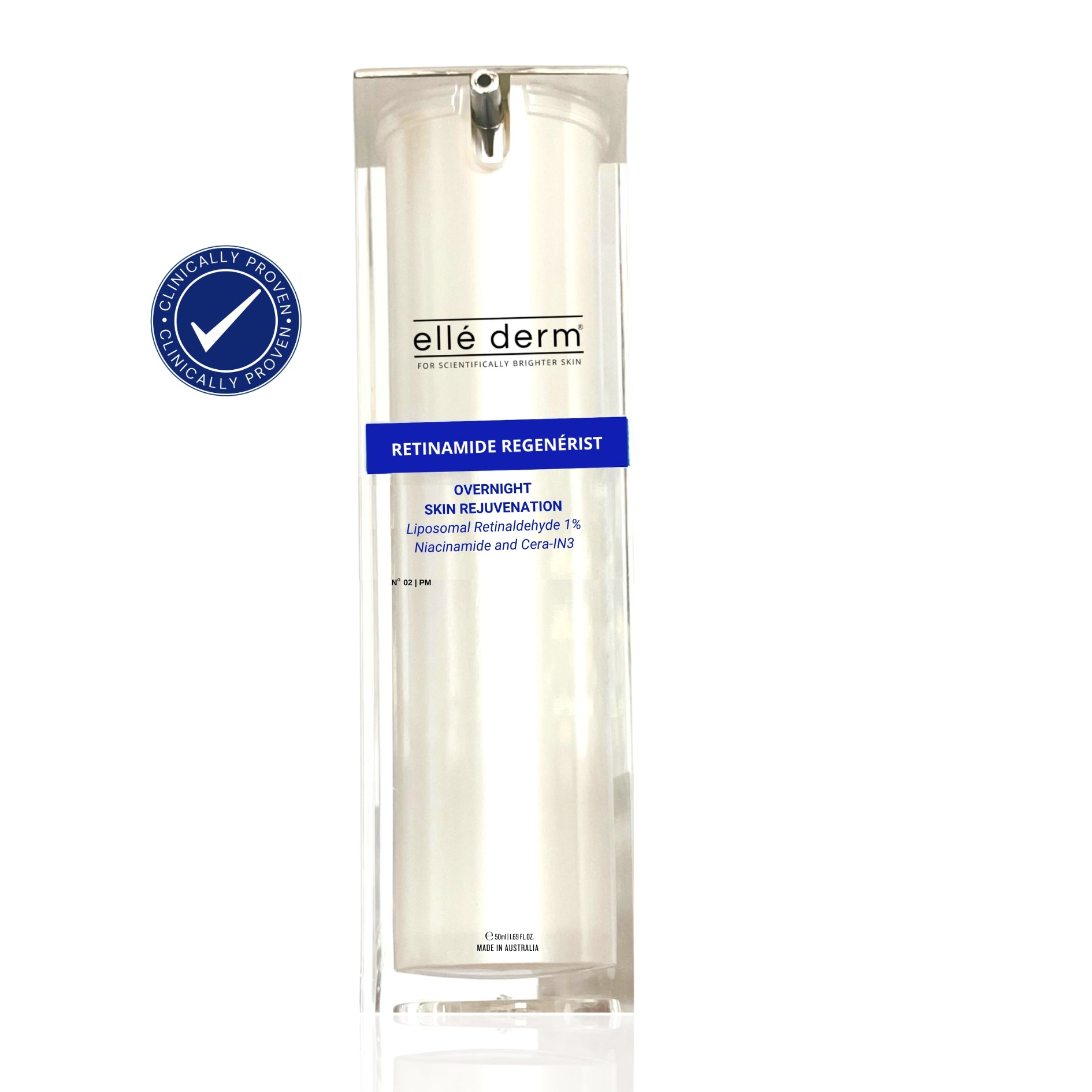
Retinaldehyde (retinal) and retinol are often used interchangeably by consumers, but they occupy distinct positions in the retinoid conversion pathway and deliver meaningfully different clinical outcomes. Here's a clear, evidence-based breakdown of how these two ingredients compare.
The Retinoid Conversion Pathway
To understand why retinaldehyde outperforms retinol, you need to understand how the skin processes vitamin A derivatives:
- Retinol → converted to retinaldehyde (one oxidation step)
- Retinaldehyde → converted to retinoic acid (one oxidation step)
- Retinoic acid (tretinoin) → the biologically active form that binds to nuclear receptors
Retinol requires two conversion steps before it becomes active. Retinaldehyde requires only one. This seemingly small difference has significant implications for efficacy and speed of results.
The Efficacy Comparison
A landmark 18-week randomized controlled trial (Creidi et al., 1998) compared 0.05% retinaldehyde to 0.05% retinol and found retinaldehyde produced statistically significant improvements in fine lines, skin roughness, and pigmentation—outperforming retinol at the same concentration. Further research by Saurat et al. (1994) demonstrated that 0.05% retinaldehyde delivered clinical results comparable to prescription retinoic acid, including increased epidermal thickness and collagen synthesis, with markedly better tolerability.
Retinol remains effective at 0.3–1.0% concentrations. Research by Kafi et al. (2007) showed 0.4% retinol significantly improved fine wrinkles and procollagen expression over 24 weeks. However, its two-step conversion to the active form means results typically take longer to manifest.
The Tolerability Advantage
Retinoid dermatitis—redness, peeling, dryness, and sensitivity—is the primary reason patients discontinue treatment. Here, retinaldehyde demonstrates a compelling advantage.
Despite being one step closer to the active form, multiple studies confirm it produces significantly less irritation than both retinoic acid and retinol at equivalent concentrations. Fluhr et al. (1999) found retinaldehyde caused minimal skin barrier disruption compared to tretinoin, making it ideal for sensitive skin, rosacea-prone individuals, and retinoid beginners.
The Acne Bonus
One often-overlooked benefit: retinaldehyde has direct antimicrobial activity against Cutibacterium acnes, the bacterium implicated in acne (Pechere et al., 2002). This property is not shared by retinol or retinoic acid, making retinaldehyde particularly valuable for acne-prone skin seeking anti-aging benefits.

Head-to-Head Summary
| Property | Retinol | Retinaldehyde |
|---|---|---|
| Conversion steps to active form | 2 | 1 |
| Relative potency | Moderate | High |
| Speed of results | Slower | Faster |
| Tolerability | Good | Excellent |
| Antimicrobial activity | No | Yes |
| Suitable for sensitive skin | Moderate | Yes |
| OTC availability | Yes | Yes (less common) |
Who Should Use Retinaldehyde?
Retinaldehyde is an excellent choice if you:
- Are new to retinoids and want to minimise the risk of irritation
- Have sensitive, reactive, or rosacea-prone skin
- Want faster results than retinol without a prescription
- Are managing acne alongside anti-ageing concerns
- Have previously experienced retinoid dermatitis with tretinoin or high-strength retinol
Who Should Use Retinol?
Retinol remains a well-validated, widely available option if you:
- Are comfortable with a gradual introduction to retinoids
- Have normal to oily skin with good baseline tolerance
- Prefer a broader range of product formulations and price points
Pharmacist's Recommendation: How to Introduce a Retinoid
Regardless of which retinoid you choose, the introduction protocol matters enormously for tolerability and long-term adherence:
- Start low and slow: Begin with 1–2 nights per week and increase frequency over 4–6 weeks.
- Apply to dry skin: Wait 20–30 minutes after cleansing to reduce irritation potential.
- Moisturise: Apply a barrier-supportive moisturiser after your retinoid, or use the "sandwich" method (moisturiser → retinoid → moisturiser).
- Use SPF daily: Retinoids increase photosensitivity. Broad-spectrum SPF 50+ is non-negotiable.
- Avoid concurrent actives initially: Hold off on AHAs, BHAs, and vitamin C until your skin has acclimatised.
Frequently Asked Questions
Is retinaldehyde stronger than retinol?
Yes. Retinaldehyde is one conversion step closer to retinoic acid (the active form of vitamin A), making it more potent than retinol at equivalent concentrations. However, it remains significantly better tolerated than prescription tretinoin.
Can I use retinaldehyde every night?
Once your skin has acclimatised over 4–6 weeks of gradual introduction, nightly use is appropriate for most skin types. Always pair with SPF during the day.
Is retinaldehyde safe during pregnancy?
All topical retinoids, including retinaldehyde and retinol, are generally avoided during pregnancy as a precautionary measure. Consult your healthcare provider for personalised advice.
How long before I see results from retinaldehyde?
Most users notice improvements in skin texture and tone within 8–12 weeks of consistent use. Significant anti-ageing benefits typically become apparent at 3–6 months.
References
- Creidi P, et al. (1998). Effect of a conjugated oestrogen cream on ageing facial skin. Maturitas; and Creidi P, et al. Profilometric evaluation of photodamage after topical retinaldehyde and retinoic acid treatment. J Eur Acad Dermatol Venereol. 1998;10(3):255–260.
- Saurat JH, et al. (1994). Topical retinaldehyde on human skin: biologic effects and tolerance. J Invest Dermatol. 103(6):770–774.
- Kafi R, et al. (2007). Improvement of naturally aged skin with vitamin A (retinol). Arch Dermatol. 143(5):606–612.
- Fluhr JW, et al. (1999). Tolerance profile of retinol, retinaldehyde and retinoic acid under maximized and long-term clinical conditions. Dermatology. 199(Suppl 1):57–60.
- Pechere M, et al. (2002). Antibacterial activity of topical retinoids. Dermatology. 205(2):153–158.